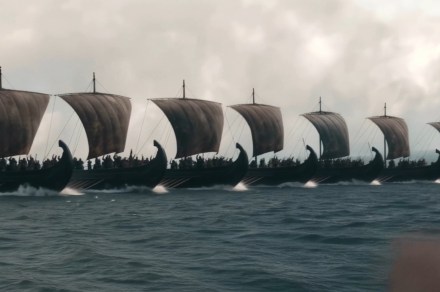
Some of the best shots in Grok Imagine’s AI-made Odyssey don’t contain actors. Ancient landscapes stretch into the distance. Close-ups of grimy hands suggest people who have touched something rougher than a keyboard. For a few seconds, the illusion holds.
Watch Episode 1 of our Odyssey series made with Grok Imagine.
— Grok Imagine (@imagine)
Let us know in the comments if you’d like a full breakdown of how it was done!
Creative collaboration with @WonderStudiosX and director Dev Walker @glumlot_ pic.twitter.com/xpgpkqSCpq
Then the people begin to move, and worse, they start speaking.
The seven-minute first episode follows Odysseus from Ithaca to Troy, then skips ahead 10 years. It feels like an extended trailer for a film that doesn’t exist. Every shot seems like an important moment, yet none stays around long enough to become one.

A story told entirely in trailer shots
Odysseus leaves Penelope and Ithaca for Troy. What never comes through is what any of it costs the people involved.
Characters stare toward the horizon while the music insists something important is happening. The episode keeps presenting moments that should carry gravitas, then moves on before anyone gets to inhabit them.
Wonder Studios and director Dev Walker shaped the generated footage into a story we can follow. That still counts for something, but coherence isn’t storytelling. An itinerary is easy to follow too, yet nobody mistakes one for an epic.
Everyone might be Odysseus
Penelope has the familiar beauty of an Instagram filter asked to look worried. Another character resembles a fake Hugh Jackman reconstructed from several unreliable witnesses. Odysseus has so few defining features that whenever another dark-haired man appeared, I wondered whether this one was him too.

The dialogue is intelligible, but the voices lack the irregular rhythm that makes speech feel lived-in. Every line lands robotically without suggesting much thought or feeling underneath. By the end, I couldn’t remember a single exchange.
The spectacle has the same synthetic discipline. Ships cross the water in tidy formation, never fully committing to the “historical accuracy” conceit it professes.
Grok can generate the idea of a hero, a wife, an army, and a fleet. Cinema needs people recognizable as individuals. That’s where the illusion breaks.
To be fair, Grok handles atmosphere beautifully, and some close-ups genuinely work. But moving pictures alone aren’t cinema. The medium lives or dies on performance, which this episode can’t generate.


Historical accuracy cannot make something art
In July, Elon Musk promised that Grok Imagine would produce a full-length Odyssey that was “historically accurate and true to the art of Homer.” His announcement followed attacks on Christopher Nolan’s adaptation, particularly its casting of Lupita Nyong’o and Elliot Page.
Historical accuracy can be a legitimate priority. If Grok’s figures more closely resemble the people its creators believe lived in Bronze Age Greece, that seems perfectly fair to me.
If Grok wants historical accuracy, it might as well finish the job. Have everyone speak reconstructed Mycenaean Greek, take the Instagram filter off Penelope, and let the soldiers break formation like frightened human beings. Then cut the gods and Cyclopes, since the historical record has been unhelpfully silent about them.
As an experiment, Grok’s Odyssey is revealing. AI can produce landscapes and isolated shots that work on their own.
For now, editors can arrange generated performances, but they can’t recover humanity that was never recorded. Grok reproduces the appearance of cinema while missing the irregularities that make someone worth following through a war.
If the AI behind it could review the episode, it might say: I have no mouth and I must scream.