As voice agents and photorealistic avatars move into enterprise software, the sales call is becoming a test case for whether AI can do more than summarize a conversation after it ends. The pressure point is familiar to anyone who has sat through a software demo: a buyer asks about a security review, integration edge case, migration plan, or competitive tradeoff, and the answer often belongs to a sales engineer who is on another call. 1mind is one company working on that shift. The San Francisco startup builds AI sales agents it calls Superhumans for web, product, email, and live sales conversations. Its Ride-Along product pushes the idea into the most sensitive part of the sales process: a named AI participant that can join a live call and answer the buyer directly.
The sidebar assistant is no longer the whole story
The first generation of sales automation made sense for the web form era. Capture the visitor. Qualify the account. Book the meeting. Push the lead into a CRM. Give the sales team a cleaner queue.
That helped sellers organize demand, but it did not remove the buyer’s friction. In many cases, it just made the handoff look smoother from the company’s side. A prospect explains the problem to a chatbot, then again to an SDR, then again to an account executive, then waits for a sales engineer when the conversation becomes technical. The company sees process. The buyer feels repetition.
1mind calls this pattern the Handoff Tax. Whatever the label, the underlying friction is one researchers of B2B buying have documented for years: when information does not move cleanly between the people a buyer is handed to, the buyer notices the seams. A delay at the wrong moment can cost momentum, though how much varies widely by deal and is hard to generalize.
The underlying issue is less about the amount of sales software than about what it was designed to do. Much of it was built to help the seller manage the buyer rather than to help the buyer get what they came for. That contrast is visible across consumer technology, where people have grown used to getting an answer, a configuration, or a purchase path in the moment. B2B software still often asks the buyer to wait for the next available human.
When the live call hits a wall
The most consequential version of the handoff happens after the buyer has already shown real intent. The meeting is on the calendar. The account executive has context. The buyer is
engaged enough to ask a hard question about security, implementation, integration, compliance, migration, or competitive fit.
Then the rep hits the boundary of their expertise.
A good rep knows not to bluff. The standard answer is familiar: the rep promises to follow up after the call. It is responsible, but it also changes the temperature of the deal. The buyer arrived ready to decide or at least narrow the field. Now the answer moves to another calendar slot, another email thread, another call with a specialist who was unavailable at the moment of need.
There is a structural reason this recurs. Technical depth tends to be unevenly distributed inside sales teams because it has to be. Sales engineers, security specialists, solutions consultants, and product experts are scarce, and few companies can staff every live conversation with every expert a buyer might need. The buyer’s hardest question often arrives when the relevant expert is somewhere else.
That gap is part of what is pushing sales AI beyond note-taking and coaching. A note-taking assistant can summarize the missed question. A coaching tool can suggest how the rep should respond next time. Both can be useful, but neither addresses the buyer’s immediate problem. The buyer does not need the seller to receive better private advice after the moment has passed. The buyer needs a credible answer while the decision is still live.
When the AI joins the call
1mind publicly launched in November 2025 with $40 million in total funding, including a $30 million Series A led by Battery Ventures. TechCrunch reported that the company, founded by Amanda Kahlow, formerly CEO of 6sense, had been used by more than 30 companies, including HubSpot, LinkedIn, and New Relic.
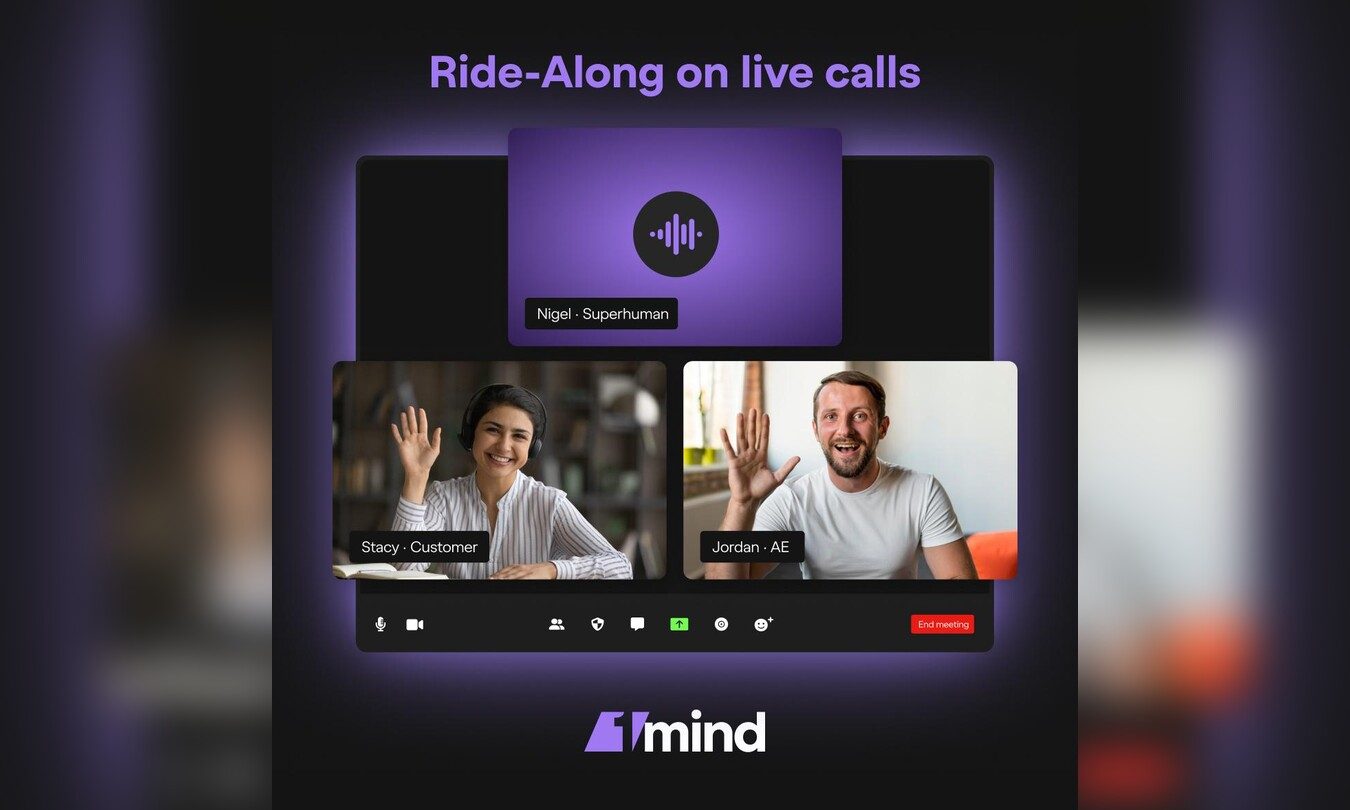
The company’s Ride-Along launch makes the strategic direction clearer. In its announcement, 1mind described Ride-Along as an AI that joins live sales calls as a visible, named sales engineer speaking directly to buyers. That buyer-facing role is the distinction that sets it apart from a private prompt stream for the rep. It is meant to become part of the meeting itself.
The idea is a sales-engineer-style participant that joins the video call beside the AE. It stays out of the conversation until called on, then answers a technical or security question, runs a demo, or pulls up the right slide, and steps back when the rep takes the lead again. It responds when prompted rather than volunteering, and is built to stay within information the company has approved.
The design points to a category difference. Rep-assist software is built to support the seller privately, while a buyer-facing participant is addressed by the buyer directly. In principle, that
can leave the human seller to keep control of the conversation, read the room, and handle strategy and trust, while technical depth is available at the moment the buyer asks for it.
The replacement question is harder to dodge, and Kahlow has not dodged it. She has told TechCrunch that the industry is not yet at the point of fully replacing the account executive, framing what remains as a trust boundary rather than a technical limit. In the near term, the clearer application is coverage. Many calls that need technical support do not get it because the bench is finite, and repeatable explanation, demo retrieval, and trained technical detail are the parts that can move closer to the buyer without assuming every sales judgment has been automated.
The post-chatbot sale looks more like consumer tech
The larger shift is toward B2B buying that feels more like the better consumer experiences. Not casual, not simplistic, just more immediate.
When a consumer configures a car, compares a laptop, changes a subscription, or asks a banking app for help, the expectation is usually not to wait a week for the specialist who owns that slice of the journey. The expectation is continuity. The system is assumed to know what the person has already done, what they are trying to accomplish, and what would move them forward.
B2B companies have been slower to deliver that kind of continuity, for understandable reasons: the buying process crosses more people and carries higher-stakes decisions. Marketing owns the first touch. Sales owns the meeting. Sales engineering owns the technical proof. Customer success owns onboarding and renewal. Each function has good reasons to exist, and the buyer tends to experience the gaps between them as delay.
1mind’s stated aim is to stretch continuity across that journey. The company positions its Superhumans as one AI memory and interface rather than a single-point tool that performs one task and disappears. In that model, the same system that greets an inbound visitor could also run discovery, support a live call, help a trial user inside the product, and carry context into customer success.
That remains more product thesis than settled market fact, and it is fair to treat it that way. The broader direction it points toward, though, is one several vendors are now betting on: AI in sales moving from back-office automation toward the buyer-facing parts of the process. On that view, these tools will be judged less by how much they save the seller and more by whether they answer the buyer faster without eroding trust.
Trust becomes the product test
Putting an AI participant in front of a buyer raises a harder standard than putting one behind the rep. A private assistant can be wrong quietly. A buyer-facing participant cannot. If it invents a security answer, overstates a feature, or wanders into pricing authority it does not have, the damage is immediate and visible to the customer.
That is why the control model can matter more than the avatar. How tightly the system stays inside approved information, and how quickly a human can take back the floor, are less eye-catching than a lifelike face or voice, but they map more directly onto the question a revenue leader actually has, which is whether the system can be relied on when a buyer asks something the seller cannot answer alone.
The next phase of AI in sales will probably not be defined by whether a tool can write another follow-up email, since that layer is already crowded. What happens in the buyer-facing moment, where a deal gains or loses momentum, is less settled. It is also where the open questions concentrate: accuracy, control, and whether a human or an AI is accountable for what gets said to the customer.
The old sales stack was built to route the buyer to the right person. The emerging test is whether AI can bring the right depth to the buyer instead, without making trust, accuracy, and authority harder to manage. That is the line between a workflow improvement and a genuine change in how B2B software gets sold.
Digital Trends partners with external contributors. All contributor content is reviewed by the Digital Trends editorial staff.