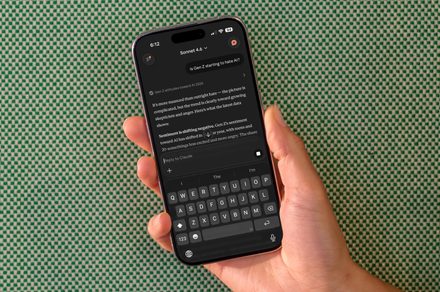
Earlier this week, my washing machine picked the worst possible time to give up. One minute it was happily churning through a load of laundry, and the next it had frozen completely, leaving me with a drum full of soggy, soapy clothes and a mysterious error code ‘ES’ flashing on the display. It was just a random combination of letters that meant absolutely nothing to me.
Like most people, I immediately turned to Reddit and Google. Surely someone else had seen this before, right? Instead, I fell into the usual rabbit hole of forum posts where every answer seemed to contradict the last. One person insisted it was a clogged filter, another blamed the motor, while someone else swore the machine was beyond saving and investing in a new one would make more sense. I worked through the obvious fixes anyway: unplugged it for a while, cleaned the filter, checked for blockages, but the washer stubbornly refused to come back to life. Eventually, I asked Claude for help. Before you question my priorities, no, I wasn’t trying to replace a repair technician with AI. I simply wanted to rule out every fix I could try on my own before admitting defeat and picking up the phone.
As a last resort, I asked Claude
Instead of typing the error code into yet another search box, I grabbed my phone and snapped a photo of the washing machine’s display. I uploaded it on Claude and explained everything I knew: the brand and model, exactly what had happened, the error code on the screen, and the troubleshooting steps I’d already gone through. I wasn’t expecting much beyond a generic list of possible causes. That’s not what happened.
Rather than immediately telling me what was broken, Claude slowed things down and started asking questions. That’s probably my favorite thing about using it. It doesn’t rush to an answer just because it can. Instead, it wanted a bit more context. Was there still water sitting in the drum? Could I hear the drain pump trying to kick in? Had I washed anything unusually heavy before the machine stopped? That last question made me pause because, yes, I had. I’d thrown in a bulky bath mat along with a couple of thick towels, and thinking back, I’d probably stuffed more clothes into the drum than I normally would. It was the first time during the whole ordeal that I started wondering if maybe I’d done something to trigger the problem.
The fix was almost embarrassingly simple
What I appreciated even more was how little effort it took to answer those follow-up questions. Claude turned them into simple multiple-choice prompts, so instead of typing out long explanations, I just tapped the option that matched what I was seeing. With that extra bit of context, the picture became much clearer. Claude explained that the error code didn’t actually indicate a dead motor or a failed control board, contrary to what I read earlier. It was far more likely to be a drainage issue. Given the heavy, overloaded wash I’d just run, there was a good chance something had shifted, clogged the pump, or blocked the drain path.

It then walked me through the checks one by one. First, the drain hose at the back of the machine. Then the pump filter hidden behind that tiny flap near the bottom — the same filter I was convinced I’d already cleaned properly, but I hadn’t. Tucked away deep inside was a lonely little sock wrapped up with a thick clump of lint, both jammed right against the pump’s impeller. I pulled everything out, put the filter back, and started a quick rinse cycle, fully expecting another error to pop up. Instead, the washer drained perfectly, spun as nothing had ever happened, and carried on with its day. After hours of Googling, second-guessing myself, and even being told I might need a new machine, the fix took all of five minutes.
Where it fell short, and where it didn’t
To be clear, this wasn’t some AI miracle. It only worked because I gave Claude a detailed prompt. I attached a photo of the error code, shared the exact brand details, explained what had happened, listed everything I’d already tried, and answered its follow-up questions as accurately as I could. The more context it had, the more useful its advice became.

Of course, there are limits. Claude couldn’t inspect the machine or confirm whether a part was faulty. If the motor or control board had genuinely failed, I’d still have needed a repair technician. What impressed me wasn’t that it fixed my washing machine; it was how it cut through the chaos. Instead of throwing a dozen possible causes at me, it asked the right questions, ruled out the unlikely ones, and gave me a logical place to start. That really stopped me from assuming the worst.
The whole thing cost me nothing
Had I gone straight for the worst-case scenario, I could’ve ended up replacing a washing machine that didn’t actually need replacing. Instead, I spent about ten minutes chatting with Claude and ended up pulling a tiny sock out of the pump filter. That’s not me saying AI should replace repair professionals — it absolutely shouldn’t. There are plenty of problems that need the right tools, hands-on experience, and someone who knows exactly what they’re doing. That’s why they’re the professionals.
But not every issue is that serious. Sometimes, all you need is a little help narrowing down the possibilities and checking the obvious things you might have overlooked. If those simple fixes don’t work, then by all means call in an expert. But before assuming your appliance is beyond saving, I’d say it’s worth spending a few minutes explaining the problem to Claude. In my case, those ten minutes saved me from spending money at all.