We may earn a commission from links on this page.
The rumors are true: Google has announced a $99.99 smart band called the Fitbit Air, and is relaunching the Fitbit app as Google Health. There’s a lot here I’m excited about: an affordable smart band without a mandatory subscription, with a full-featured app that may, if Google’s promises check out, offer a meaningful alternative to Whoop’s app. Here’s what we know about the band, and how it’s going to fit into the ecosystem if you already have a Fitbit or a Pixel Watch.
The band is impressively lightweight and comfortable-looking

Credit: Fitbit
I haven’t yet seen the Fitbit Air in person (although I expect to give you a hands-on review soon), but from the pictures, I’m impressed with the design. Remember when I was trying to figure out from photos whether the device is attached to the strap, since I couldn’t see a connecting piece? Well, it turns out that the Fitbit Air device (the “pebble”) pops into the underside of the strap, like the old Fitbit Flex. That means you can swap out the strap for a different color or material, without any hardware showing.
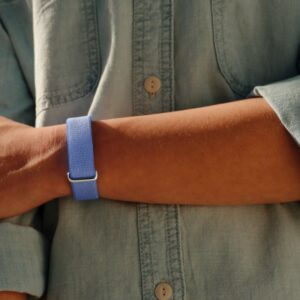
The device is 1.4 inches by 0.7 inches by 0.3 inches. It weighs 5.2 grams, and 12 grams with the band. The color offerings include black, light gray, a bluish color that Fitbit calls Lavender, and a pinkish red it calls Berry. (Lavender is shown in the image at the top of this page.) So what happened to the gray-and-orange band Stephen Curry has been wearing? That’s a special edition, complete with his jersey number worked into the stitching. It will retail for $129.99. With a regular band, the price is $99.99. Replacement bands (without the device) will retail for $34.99. The Fitbit Air is available to pre-order now, and will ship later this month.
What the Fitbit Air actually does
The Fitbit Air, like the Whoop and other smart bands before it, is mainly a heart rate sensor that can pair to your phone. There is no display; if you want to see your heart rate during a workout, you’ll need to check that from your phone. Unlike the old Fitbit Flex, which had some indicator lights, the Fitbit Air doesn’t have any kind of display.
The Fitbit Air also includes accelerometers to detect motion, a blood oxygen sensor, and a vibration motor. There is a temperature sensor so the device can report skin temperature variations, but Google said in a briefing that it’s not sensitive enough for menstrual cycle tracking. The device also has enough storage to hang onto your workout data for a day before needing to sync to your phone, so you don’t need to have your phone with you for every workout.
You can now pair a Fitbit and a Pixel Watch to the same phone
I have good news and bad news on multi-device support. Fitbit users have long complained that the Fitbit app only allows you to pair one device. Pixel watches use this same app, so when I reviewed the Pixel Watch 4 I had to unpair the Fitbit Charge 6 that I had previously paired. That is changing! You will now be able to pair a Pixel Watch and a Fitbit.
But that is specifically the only combination you’ll be able to do, Google says: one Pixel and one Fitbit. So you can wear a Pixel Watch and swap it for a Fitbit Air for workouts or sleep or any time you don’t want a watch on your wrist. But you can’t swap between a Fitbit Charge 6 and a Fitbit Air, or between any other two Fitbits. That’s a shame for people who already own a Fitbit device that tells the time.
The Fitbit Public Preview will become the new Google Health app
The Fitbit app is getting an overhaul and a new name, and it sounds like it’s going to be great. That said, my initial experiments with the Public Preview did not inspire confidence. I found that the AI coach hallucinated freely, kept forgetting my goals, and generally made a terrible coach.
Google says it’s been listening to feedback, and that fixes are either in the works or have already been applied. The Public Preview was missing key features while it was in development, like nutrition tracking, but those will be available at the relaunch. Google says the developers have made information easier to find, the coach less verbose, and the coach now tracks your progress toward weekly goals.
I’m looking forward to trying the app, and I won’t pull any punches if the coach still has serious flaws. It doesn’t exactly inspire confidence that I saw this on Reddit yesterday: A Public Preview user said that the coach keeps insisting they need to wake up at 5:30 a.m. and recently went through a big move, neither of which were true. Another redditor replied to say they were a product manager at Google and said “sorry to hear about these hallucinations. we’ve seen a number of these and have made some progress getting rid of them, so it’s helpful to dig into the ones that are still happening.”
If Google can successfully address the coach’s issues, I’m going to be really impressed with the app. I’ve been saying for years that you don’t make a Whoop killer by sticking a heart rate monitor on a wrist band—Whoop’s strength is its incredibly full-featured app that integrates all your data into actionable advice. I love Whoop’s app for its weekly plans and I’ve joked that the Whoop Coach is “the only AI I’m on speaking terms with.” Fitbit’s new app will have weekly plans, and its coach is programmed to take input from conversations and to access data from throughout the app. It sounds a lot more useful than a lot of fitness app chatbots.
How the Fitbit Air compares to other smart bands
I’m honestly excited for this. There are now multiple smart bands on the market, but the Fitbit Air seems to be hitting a sweet spot that none of the others have gotten quite right. Whoop is undeniably the leader, but its $239/year subscription is a lot for most of us to swallow. Polar’s no-subscription Loop band sounded promising, but ultimately doesn’t do very much, and it’s $200. Amazfit’s Helio strap was my favorite of the bunch, with a $99.99 price tag, no subscription, and the ability to trade off with other Amazfit devices (like the company’s sports watches) in a no-frills app.
The Fitbit Air combines the low price tag, no subscription, and (possibly) a full-featured, easy-to-use app. It can feed data to the same app as a watch you might already be wearing—at least if you’re a Pixel watch user. I’m looking forward to trying it out and seeing whether the app keeps its promises well enough to give it the edge over other smart bands.