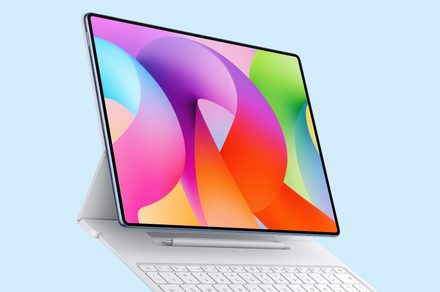
Huawei just launched the MatePad Pro Max, and it’s a lot to take in. At just 4.7mm thick and weighing 499 grams, it officially takes the crown as the world’s thinnest tablet. For context, the iPad Pro, which we all fawned over for being impossibly slim, is 5.1mm thick. The MatePad Pro Max beats it.
Now, there’s a decent chance you’ll never actually buy this tablet. Huawei devices aren’t sold in every market, and the lack of Google apps is a real barrier for most users. But there’s no denying that Huawei is doing things that even Apple can’t match.
How does it compare to the iPad Pro?
Whenever a new tablet launches, it’s natural to compare it to the iPad, as the latter not only popularized the form factor but also holds the biggest market share. In that regard, the Huawei MatePad Pro Max directly competes with the iPad Pro, and it outshines Apple’s best tablet in several areas.

The MatePad Pro Max sports a 13.2-inch flexible OLED display with a 3000 x 2000 resolution, 144Hz refresh rate, 1600 nits peak brightness, and a 94% screen-to-body ratio. The iPad Pro uses a very capable OLED panel too, but the MatePad’s nearly borderless look, with just a 3.55mm bezel, makes it feel more immersive.

The MatePad Pro Max also packs a 50MP rear camera, which is something Apple has never put in an iPad Pro. Yes, you will not use a tablet to capture photos often; however, it’s always better to get the best for the price you pay.
What else do you get for the price?
The MatePad Pro Max has a six-speaker system tuned by Huawei Sound, with a quad-driver bass unit. Add a 10,400 mAh battery that lasts up to 14.5 hours of local video playback and 66W fast charging, and you get a complete media-consumption powerhouse of a tablet.

Other standout features include a comprehensible cooling system with a dual-layer VC structure that enables sustained performance, keyboard and stylus support, multi-window support, and more.
For those who can actually buy it, this is a very compelling package. For everyone else, it’s at least a glimpse at what’s possible when a company decides to push the hardware as far as it will go.