Solar panels are great for the planet, but have long been a headache for architects, homeowners, and historic preservation boards. That tension between sustainability and aesthetics may finally have a real solution.
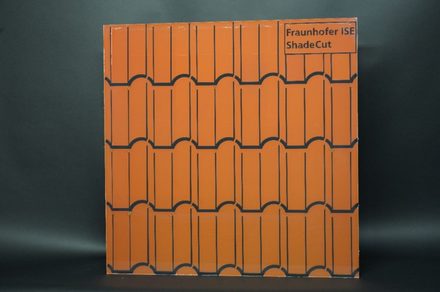
Researchers at the Fraunhofer Institute for Solar Energy Systems ISE in Germany have developed a technology called ShadeCut, which applies colored, patterned films to solar modules that can convincingly mimic roof tiles, masonry, or even custom logo designs.
What is ShadeCut and how does the colored solar panel technology work?
ShadeCut builds on an earlier Fraunhofer invention, called MorphoColor, a bio-inspired coating technology inspired by the Morpho butterfly. That butterfly’s wings produce vivid, iridescent color not through pigment but through microscopic 3D photonic structures that manipulate light with minimal energy loss.

Fraunhofer researchers replicated this effect on the back of solar module cover glass using a vacuum process, producing stable colors across various viewing angles. ShadeCut takes this further by using laser or CAD-controlled processes to cut precise patterns and transparent cutouts into the colored films.
Layering multiple cutout films also allows the use of additional colors and more complex designs. The result is a solar module that looks like terracotta tiles, stone, or branded graphics rather than a standard panel.
How efficient are colored ShadeCut solar panels compared to regular panels?
Independent testing confirms that ShadeCut modules retain roughly 95% of the power output of a standard uncoated panel. That makes this technology significantly more competitive than comparable aesthetic solar solutions already on the market.
The technology works with all standard photovoltaic and solar thermal modules. It is particularly well-suited for building-integrated photovoltaics, where solar panels are embedded directly into a building’s structure rather than mounted on top.
Historic buildings and design-sensitive projects have traditionally resisted standard black or blue panels. ShadeCut could change that conversation entirely. The modules will be shown publicly for the first time at The Smarter E/Intersolar Europe 2026 in Munich between June 23 and 25.