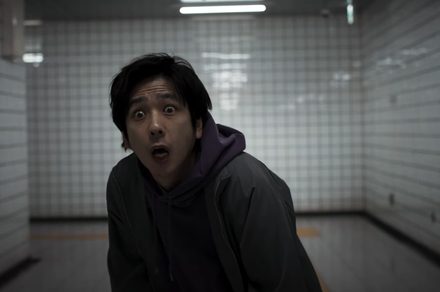
Video games have gotten better film and TV adaptations these days. Since 2020, we’ve gotten hits like the Sonic the Hedgehog movies, HBO’s The Last of Us, and Netflix’s Arcane. Now, indie film distributor NEON (Parasite, Anora) has joined in on this modern trend by screening one of the best video game movies ever, Exit 8. Directed and co-written by Genki Kawamura, this liminal horror film is based on the walking simulator, The Exit 8, by indie developer Kotake Create.
Exit 8 follows “The Lost Man” (Kazunari Ninomiya) as he tries to find his way out of a Tokyo subway tunnel that constantly repeats itself. To escape, he must follow these rules: “Do not overlook anything out of the ordinary. If you discover an anomaly, turn back immediately. If you don’t, carry on. Then leave from Exit 8.” Even the slightest mistake sends the protagonist back to the beginning, and the anomalies range from small to immensely terrifying.
In an interview with Digital Trends, Kawamura discusses how he was inspired to take a simple video game and transform it
This interview has been edited for length and clarity.

Digital Trends: Now, to get started… how are you feeling today?
Kawamura: I’m really excited by how the U.S. audience is going to respond to this movie. I know it’s a very bizarre, probably not like your standard, movie. So with the U.S. release around the corner. I’m excited to see how the response is going to be.
Digital Trends: Well, as a U.S. citizen who saw an early screening, I think they’re really going to love it. Now Exit 8 is based on a popular video game. Could you tell me how you approached adapting it into a feature-length film?
Kawamura: As soon as The Exit 8 came out[I] played the game right away, and then went on to watch a lot of different streamers and their archives, and it dawned on me that there were as many stories as there were people playing this game.
There were as many instances of drama as there were players. And I go back to a panel that I did with Miyamoto Shigeru from Nintendo, where he said, “Truly great games. It not only has to entertain the player, but it has to entertain the people watching the player play the game as well.”
So with this movie, I set out to capture that phenomenon that’s happening within the video game industry itself where there are players, there are streamers, and there are viewers watching the streamers.
Digital Trends: Right. And personally, I think the movie is incredible. I was truly amazed by the camerawork and how you were able to perform so many long takes in this hallway that’s constantly changing. Could you tell me more about how you filmed the scenes on that set?
Kawamura: Well, I wanted to keep the secret, but I’ll give you a peek. We actually made two identical corridors. So it was like a copy-and-paste. There were two physical corridors back-to-back, and that’s what enabled us to do the single-cut looping shots physically.
So the Walking Man, Kochi Yamato, the actor, he would, for example, walk down the corridor once, and as soon as he walked past the camera, would run to the exit, get on a bicycle, bike to the beginning of the other corridor, catch his breath, and begin walking again.
So our filming methods were very practical and analog because I didn’t want to use CG if at all possible. And because we had two identical corridors, the casting crew would get lost oftentimes. So we had to name the corridors. We named one corridor “Hitchcock” and the other one “Kubrick.”
Digital Trends: Amazing. Now, I’ve seen videos of The Exit 8 game, and [the film] really captures the look and feel of the source material. I know you had to build the film story from the ground up, as the game had no story. One of the biggest differences I noticed was that the protagonist…he’s about to be a father. Why did you decide to make a story about that?

Kawamura: I commute on the subway system in Tokyo to get to work every day, and there are many people I share the subway with, but we’re all on our smartphones. So it feels very isolated, and to the point where I’m sure a lot of people won’t even notice a crying baby on the train. And even with our smartphones, on our timelines, there are instances of war, of violence that we’ll scroll right past.
So I don’t think anyone on the train is responsible for directly killing anyone else, but I think there are a lot of anomalies happening that we just scroll right past and ignore, and we’re all guilty of this. So what if that guilt manifested itself in this white, sanitized corridor as anomalies and were reflected back on the people who scroll past them? I think that is what might truly be terrifying.
Likewise, our main character and I think [that] our society at large has become more and more selfish. So this idea of taking responsibility for a brand-new life is something that I don’t think a lot of consideration is given to, especially from the main character.
Digital Trends: Yeah, I picked up a lot of those themes from the story. Now, since the movie shows the characters going down the same hallway over and over again, did you fear that the film would get too repetitive for the audience as a feature-length film? How did you keep the film engaging and surprising to your audience?
Kawamura: How I did that part of it was the characters. So I wanted to capture the idea of you’re watching different livestreams of different players, and by switching the point of view or the characters that were following, I think we’re able to keep the audiences engaged.
And at the same time, as we were developing the film, the corridor itself began to take on this characteristic of its own, and I would even argue that the corridor could be the main character of this film.
The corridor is almost like this monster that takes on a will of its own as it sort of toys with the humans that enter it, and this sign, “Exit No. 8.” This yellow sign it oversees all of it is almost this divine creature, this God that’s watching humans within the corridor. So it feels like how from 2001: A Space Odyssey, if we can get the corridor and the sign to have that kind of projection. I thought that would be really interesting.
Digital Trends: Yeah, it’s funny you mentioned that because I did see the hallway as a sort of a sentient entity, but I was getting more of the hotel from Stanley Kubrick’s The Shining. Was that one of your influences in making the story?

Kawasura: It was a very big influence, and I’m glad that you were able to pick up on that reference.
Digital Trends: Thank you. Now, I read online that there have been talks about an English remake of Exit 8 getting made, as well as remakes being made by filmmakers and many other countries. Have there been any updates about where the franchise is going to go going forward?
Kawamura: I’m currently touring in the United States, and we’re also taking meetings for different potential remakes, but I think to myself that it’d be really cool to see different cities and their own subway and underground networks and systems because I think each Exit 8 is going to have its own drama.
Each city will have its own Exit 8, which will have its own drama. So if there’s this larger Exit 8 universe where all the different stories are kind of part of the universe, that would be really, really cool.
Digital Trends: Yeah, I’m really looking forward to seeing where the franchise takes you. Do you have any other films or TV shows in development at the moment?
Kawamura: My latest novel is coming out this autumn. It’s titled The Horse and I, based on a true story, where a woman embezzles $10 million and spends it all on her riding horses. It’s going to be a thriller. So that’s what I’m working on at the moment.
Digital Trends: That sounds pretty exciting. And now, on the topic of thrillers, I’ve seen from your past filmography that you haven’t done a lot of scary movies…Can you tell me how you approach creating horror and terrifying your audience in film?
Kawamura: I have a lot of history producing animation in Japan, and there are a lot of legends that precede me, Kon Satoshi, Oshii Momoru. These legendary animation directors are really good at taking what’s happening within the human mind and within the human head and sort of putting that out, like projecting it outside into the world and different visual expression.
And I thought if I could somehow do that using the live-action medium, that would create a different kind of moviegoing experience. And for me personally, I find what happens within the human mind much more terrifying than monsters or ghosts.
Exit 8 is in U.S. theaters on April 10.