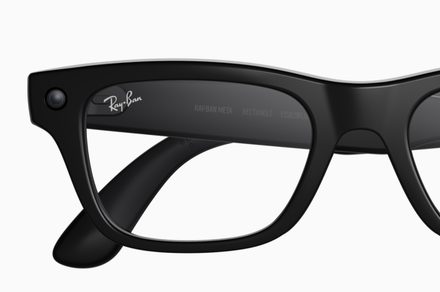
Meta has announced a new generation of AI-powered smart glasses designed specifically for prescription users, marking a major step toward making wearable technology more practical for everyday life. Developed in partnership with eyewear giant EssilorLuxottica, the new models aim to bridge the gap between traditional eyewear and AI-driven functionality.
Designed for vision and intelligence
The newly introduced smart glasses – part of Meta’s Ray-Ban lineup – are built from the ground up to support prescription lenses across a wide range of vision needs. Unlike earlier models that offered limited compatibility, these new versions are optimized for people who rely on glasses throughout the day.
The glasses will be available in multiple styles, including rectangular and rounded frames, and are designed with adjustable temple tips, interchangeable nose pads, and flexible hinges for a more personalized and comfortable fit.
Starting at $499, the devices will be sold through Meta’s online store as well as traditional optical retailers, with availability beginning in the United States before expanding to other markets.
A push toward mainstream wearable AI
Meta’s latest move highlights a clear shift in strategy: turning smart glasses into everyday essentials rather than niche gadgets. By integrating prescription support directly into the design, the company is addressing one of the biggest barriers to adoption.

Billions of people worldwide require vision correction, and until now, many had to choose between wearing their prescription glasses or using smart eyewear. Meta’s new approach eliminates that compromise, making AI glasses more practical for daily use.
The glasses also continue to build on Meta’s AI ecosystem, offering features like voice-controlled assistance, messaging, navigation, and content capture. New updates include tools such as hands-free nutrition tracking, message summaries, and improved navigation capabilities, signaling deeper integration of AI into everyday interactions.
What’s inside these glasses?
Beyond the fresh looks, the Ray-Ban Meta Blayzer Optics (Gen 2) and Ray-Ban Scriber Optics (Gen 2) smart glasses share the technical architecture with the mainstream Ray-Ban Meta (Gen 2) frames. Starting with their social credentials, they can record 3K Ultra HD clips courtesy of the onboard 12-megapixel wide-angle camera.
Meta is touting eight hours of operational time per charge, while the case can add 48 hours worth of juice. The audio array includes six mics, while media storage is deputed to the 32GB storage module. The more notable difference is the added 10 degrees of extra freedom with the extension hinge. Furthermore, the nose pads are interchangeable, while the temples are also comparatively more adjustable to ensure a snug fit.
Why this matters for the industry
The launch of prescription-ready AI glasses is significant not just for Meta, but for the broader tech industry. It reflects a growing belief that smart glasses could eventually replace or complement smartphones as primary computing devices.
By focusing on usability and comfort, Meta is positioning itself ahead of competitors like Google, Snap, and emerging players in the wearable AI space. The company already leads the smart glasses market and is now doubling down on accessibility to expand its user base further.
What it means for consumers
For users, the biggest advantage is convenience. These glasses allow people to combine vision correction with AI-powered features in a single device, removing the need to switch between products.

The improved design also suggests that Meta is targeting all-day wearability, making the glasses suitable for work, travel, and everyday activities. However, some limitations remain, such as prescription range restrictions for direct online purchases, which may require users to visit optical stores for full customization.
What comes next
Meta is expected to continue expanding its smart glasses ecosystem with enhanced AI capabilities, broader global availability, and deeper app integrations. Future updates could bring more personalized experiences, improved on-device processing, and tighter connections with Meta’s platforms.
As competition in the wearable space intensifies, Meta’s prescription-focused approach signals a clear direction for the industry: smart glasses are evolving from experimental tech into practical, everyday tools.
With this launch, Meta is not just improving its product – it is redefining how AI can seamlessly fit into daily life.