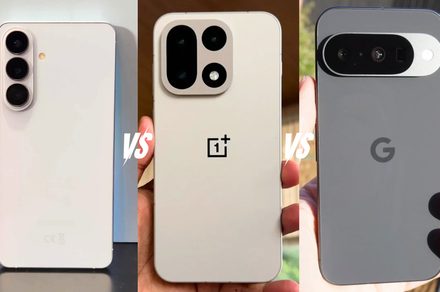
The Samsung Galaxy S26, OnePlus 15, and Google Pixel 10 all land within shouting distance of each other on price, run the same operating system, and target roughly the same buyer. But spend any real time with them and it becomes clear that each one is making a completely different argument for why you should hand over your money.
This piece breaks down where each phone genuinely earns its price tag — hardware, software, cameras, battery, and everything in between — so you don’t have to figure it out the hard way.
Price and availability
The Galaxy S26 and OnePlus 15 both start from $899 for the 256GB variants — OnePlus steps to $999 for the 512GB storage variant, the S26 goes higher to $1,099. Samsung launched February 25, with the phone actually in stores from March 11, 2026.
The Pixel 10 undercuts both at $799 for 128GB — and that’s the launch price. Google released it back in August 2025, which means it’s had months of discounts piled on top.
Galaxy S26 vs. OnePlus 15 vs. Pixel 10: Tech specs
| Specifications | Galaxy S26 | OnePlus 15 | Pixel 10 |
| Dimensions | 149.6 x 71.7 x 7.2 mm | 161.4 x 76.7 x 8.1 mm | 152.8 x 72 x 8.6 mm |
| Weight | 167g | 211g / 215g | 204g |
| Build | GG Victus 2 front & back, aluminum frame | GG Victus 2 front, aluminum frame, glass/fiber back | GG Victus 2 front & back, aluminum frame |
| IP Rating | IP68 (1.5m, 30 min) | IP68 / IP69K (2m, 30 min) | IP68 (1.5m, 30 min) |
| Colors | Cobalt Violet, Sky Blue, Black, White, Silver Shadow, Pink Gold | Infinite Black, Ultra Violet, Sand Storm | Indigo, Frost, Lemongrass, Obsidian |
| Display Type | Dynamic LTPO AMOLED 2X | LTPO AMOLED (BOE X3) | OLED |
| Size | 6.3 inches | 6.78 inches | 6.3 inches |
| Resolution | 1080 x 2340 (411 ppi) | 1272 x 2772 (450 ppi) | 1080 x 2424 (422 ppi) |
| Refresh Rate | 1–120Hz adaptive | 1–165Hz adaptive | 1–120Hz adaptive |
| Peak Brightness | 2,600 nits | 1,800 nits (HBM) | 3,000 nits (peak) |
| HDR | HDR10+ | Dolby Vision, HDR10+, HDR Vivid | HDR10+ |
| Chipset (US) | Snapdragon 8 Elite Gen 5 (3nm) | Snapdragon 8 Elite Gen 5 (3nm) | Google Tensor G5 (3nm) |
| CPU | Octa-core (2 x 4.74 GHz + 6 x 3.62 GHz Oryon V3) | Octa-core (2 x 4.6 GHz + 6 x 3.62 GHz Oryon V3) | Octa-core (1 x 3.78 GHz X4 + 5 x 3.05 GHz + 2 x 2.25 GHz) |
| GPU | Adreno 840 | Adreno 840 | PowerVR DXT-48-1536 |
| RAM | 12GB | 12GB / 16GB | 12GB |
| Storage | 256GB / 512GB | 256GB / 512GB / 1TB | 128GB / 256GB |
| Storage Type | UFS 4.x | UFS 4.1 | UFS 3.1 / UFS 4.0 |
| OS | Android 16, One UI 8.5 | Android 16, OxygenOS 16 | Android 16 (Stock) |
| Update Promise | 7 major OS upgrades | 4 years OS, 5 years security | 7 major Android upgrades |
| Cameras – Main | 50MP, f/1.8, 1/1.56″, OIS | 50MP, f/1.8, 1/1.56″, OIS | 48MP, f/1.7, 1/2.0″, OIS |
| Ultrawide | 12MP, f/2.2 | 50MP, f/2.0 | 13MP, f/2.2 |
| Telephoto | 10MP, f/2.4, 3x optical | 50MP, f/2.6, 3.5x optical | 10.8MP, f/3.1, 5x optical |
| Video | 8K@24/30fps, 4K@30/60fps | 8K@30fps, 4K@120fps | 4K@60fps |
| Selfie Camera | 12MP, f/2.2, dual pixel PDAF | 32MP, f/2.4, AF | 10.5MP, f/2.2, PDAF |
| Selfie Video | 4K@30/60fps | 4K@60fps | 4K@60fps |
| Speakers | Stereo | Stereo, Hi-Res 24-bit/192kHz | Stereo |
| Wi-Fi | Wi-Fi 7 (tri-band) | Wi-Fi 7 (tri/dual-band) | Wi-Fi 6E (dual-band) |
| Bluetooth | 5.4 | 6.0 (aptX HD, aptX Adaptive, LHDC 5) | 6.0 (aptX HD) |
| NFC | Yes | Yes | Yes |
| USB | USB-C 3.2, DisplayPort 1.2 | USB-C 3.2, OTG | USB-C 3.2 |
| Satellite | Yes | No | Yes (SOS) |
| Fingerprint | Under-display, ultrasonic | Under-display, ultrasonic | Under-display, ultrasonic |
| Battery Capacity | 4,300 mAh | 7,300 mAh (Si/C) | 4,970 mAh |
| Wired Charging | 25W (55% in 30 min) | 120W (50% in 15 min) | 30W (55% in 30 min) |
| Wireless Charging | 15W | 50W (proprietary) | 15W (Qi2) |
| Starting Price | $899.99 (256GB) | $899.99 (256GB/12GB) | $799 (128GB) |
| Top Config | $1,099.99 (512GB) | $999.99 (512GB/16GB) | $899 (256GB) |
Samsung Galaxy S26: The most complete AI suite on a smartphone

At 7.2mm, the S26 is the slimmest phone in this comparison — noticeably so next to the OnePlus 15’s 8.1mm and the Pixel 10’s 8.6mm. Honestly, I usually prefer function over form, but the fact that S26 maintains the slimmest profile and yet provides flagship performance, is something that makes me want to change by beliefs.
The 6.3-inch 120Hz AMOLED is punchy and bright at 2,600 nits peak (I’ve used the display on the Galaxy S25, with no real-world issues or problems). What makes Samsung’s chip different is the “for Galaxy” customization — Samsung works directly with Qualcomm to tune the CPU, GPU, and NPU specifically for One UI.

Galaxy AI was already the most feature-complete AI suite of any Android phone before the S26 shipped. With One UI 8.5, Samsung widened that gap further — adding Now Nudge (context-aware screen suggestions), Now Brief (personalized daily digest), and text-prompt-based Photo Assist edits, while expanding existing tools like Audio Eraser to work inside third-party apps like Instagram and YouTube, and upgrading Smart Call screening to full live-transcription with text replies.
It goes without saying, but Galaxy AI actually offers more features than one can possibly remember and use on a day-to-day basis. But it is better to have it and not need it than to need it and realize that other brands are doing much better (I wasn’t talking about the iPhone 17 at all).

On top of that, DeX — a full windowed desktop when plugged into a monitor — has no equivalent on either the OnePlus 15 or Pixel 10. Seven years of operating system updates is probably more than you’d need, given that users change their phone every three to five years anyway.
OnePlus 15 clearly wins the hardware battle
The OnePlus 15 doesn’t win on software depth or AI features — it’s here because the hardware it ships with at $899 is genuinely difficult to argue against.

First things first, the phone comes with both IP68 and IP69K ratings — the second one means it can handle high-pressure water jets, something neither the S26 nor the Pixel 10 can claim. Neither I nor any other careful user would want to put that rating to test, but it’s there, just in case.
The OnePlus 15 runs a 6.78-inch FHD+ AMOLED at 165Hz — the highest refresh rate in this comparison, and the first display above 1080p to hit that number. Back that display up with a dedicated 3200Hz touch sampling chip and, ideal for fast-paced games.

Under the hood, it’s the Snapdragon 8 Elite Gen 5 — same silicon as the S26, minus Samsung’s custom prime core overclock. The camera system puts a 50MP sensor behind all three lenses — main at f/1.8, ultrawide, and a 3.5x periscope telephoto — a hardware consistency the other two don’t match.
OxygenOS 16, like the other Chinese skins atop Android 16, reminds me of Apple’s Liquid Glass interface on iOS 26. The standout is Mind Space (with Google Gemini integration) — a personal AI knowledge hub where a three-finger swipe saves anything on screen instantly: articles, photos, voice memos, screenshots. The physical Plus Key gives one-press access to it from anywhere on the phone.

Battery is where this phone just runs away from the other two — 7,300mAh against the S26’s 4,300mAh and the Pixel 10’s 4,970mAh — it’s not a close fight. Use it lightly and two days between charges is genuinely on the table. OnePlus also throws the 120W charger in the box, which neither competitor does.
Google Pixel 10: Cleanest Android and most consistent cameras
At 204g and 8.6mm, the Pixel 10 is the heaviest and thickest phone here — Google clearly isn’t chasing the slim phone crowd, and the 6.3-inch 120Hz OLED, IP68 rating, and Gorilla Glass Victus 2 are quite standard at this point.

The Tensor G5 is where things get interesting. Built on TSMC’s 3nm node — a deliberate departure from Samsung’s fabs that plagued earlier Tensors with heat issues — it still trails the Snapdragon 8 Elite Gen 5 in raw benchmarks. Google isn’t trying to win that fight. What they built instead is an NPU that’s 60% stronger than the G4’s, runs Gemini Nano 2.6x faster, and keeps 20-plus AI features running locally on the chip itself.
That software is the real argument. Pure Android, no manufacturer skin, updates arrive here first. Quarterly Pixel Feature Drops add new capabilities between OS releases — something Samsung and OnePlus don’t do.

The AI suite includes Magic Cue (cross-app contextual suggestions), Voice Translate (real-time on-device call translation in your own voice), Scam Detection (Gemini Nano-powered call screening), Call Notes (auto transcription with post-call task suggestions), and Pixel Screenshots (searchable, NotebookLM-connected screenshot library).
Speaking of which, the Pixel 10’s camera — 48MP main, 13MP ultrawide, telephoto — doesn’t impress on paper. Never has. But Google has spent three years building a reputation for the most natural, accurate shots of any Android phone without you touching a single setting, and that’s still true here.

It is the stock Android experience and the cameras that I’d buy the Pixel 10 for, not anything else. Battery is 4,970mAh on 30W wired charging — slowest in this comparison. However, it supports Pixelsnap wireless charging (Qi2-compatible).