AI was meant to explain and augment human intelligence. Why aren’t we getting any closer?
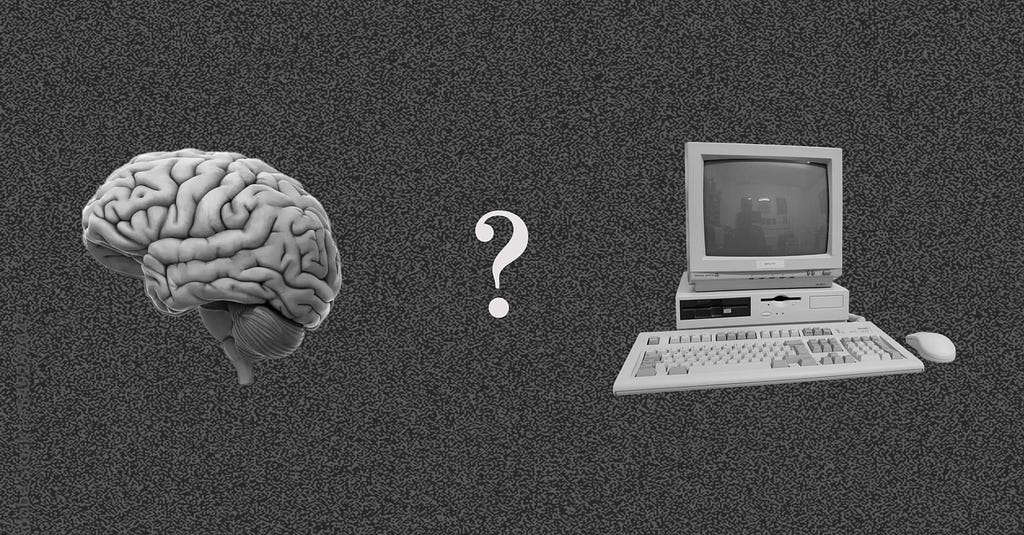
Nearly every modern conversation about AI begins by acknowledging how transformative it is for everyday life — how it’s changing routines, replacing jobs, restructuring our social networks. As with any kind of rapid and uncontrollable change, opinions about it are polarised: skeptics are wary about AI’s larger effects on society — unemployment, mental health, environmental concerns. AI optimists, on the other hand, believe these tools will herald a new age of tools for thought — the next breakthrough in collective intelligence, akin to the emergence of writing systems, printing, or mathematical abstraction.
But one thing is clear: the focus is almost exclusively on AI functionality — what tasks AI can solve more efficiently, how to use it to get the most out of it, how to build workflows around it. This, perhaps, is not in itself surprising: with the plethora of models, tools, and chatbots available, even those grappling with AI on a daily basis — researchers, software designers, developers — struggle to make sense of them all.

But when I asked Claude to tell me about some traditionally human cognitive abilities that AI now has, I was surprised that it appended the expected list (pattern recognition, language understanding, learning from experience) with the following:
What’s interesting is that AI often achieves these abilities through completely different mechanisms than humans — we don’t truly “understand” in the way you do, and we lack consciousness, genuine emotions, and embodied experience. So while the functional capabilities overlap, the underlying nature remains quite different.
Yet we rarely discuss that underlying nature — what exactly makes models like Claude different from human thinking, or what these differences reveal about intelligence itself.
If AI has been heralded as a new chapter in what humans are capable of, shouldn’t we be asking more fundamental questions about what “intelligence” actually means, and what kind of shared human-computer intelligence the future could hold?
From minds to machines
Today’s public discussion of AI is almost completely divorced from discussions of human cognition—and surprisingly so, given that the field of artificial intelligence research was founded on questions borrowed directly from the philosophy of mind and psychology.
Much of the Western philosophy of mind has been preoccupied with the mind-body problem — the relationship between mental states and the physical reality and perception. With questions like: what kind of structures and elements comprise human knowledge? What is thinking? Is having a mind the same as having a brain? These questions echoed through Alan Turing’s seminal work “Computing Machinery and Intelligence,” the 1950 paper published in Mind that introduced what we now know as the Turing test.
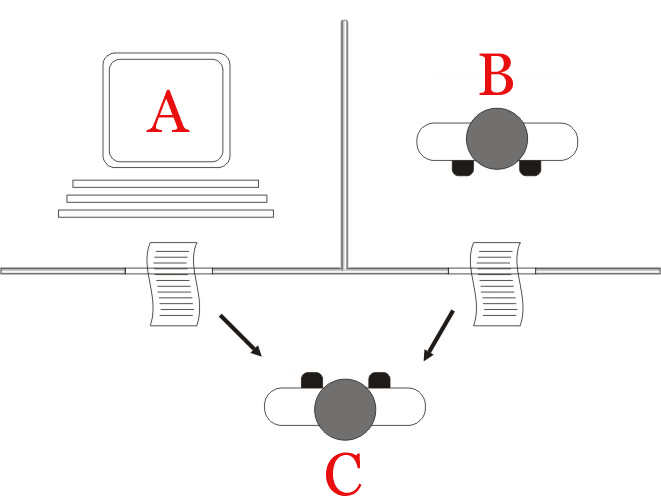
Turing argued that instead of focusing on the question “Can machines think?”, more can be learned from their observed behaviour. He proposed an “imitation game” (the original name for the Turing test) — a hypothetical scenario in which a human evaluator has text-based conversations with two hidden participants: one human and one machine. If the evaluator can’t reliably tell which is which based on their responses, the machine is said to have passed the test.
For a while, the discussion around creating a human-like “learning machine” was theoretical. But the advancements in the understanding of the brain’s neural structure throughout the 19th and 20th centuries established the electrical nature of the nerve signal, culminating in neuropsychologist Donald Hebb’s theory on the neural processes that underlie learning. In his 1949 book The Organization of Behavior, Hebb theorised how neural connections form through repeated activation — a principle later summarised as “Neurons that fire together, wire together.” This insight provided the foundation for modern neuroscience, neural network theory, and machine learning.

Early pioneers of AI believed that describing the mind in computational terms — made possible by Hebbian theory and the subsequent development of artificial neural networks — could finally answer those foundational questions about human cognition. If they could build computational systems that closely resembled the brain’s neural structure, they reasoned, those systems might recreate the processes underlying uniquely human abilities: language, visual perception, reasoning, artistic creation.
As work on understanding the mind unfolded throughout the 20th century, two competing views of intelligence emerged: pattern recognition (also known as “statistical processing”) and world modelling (known as “symbolic manipulation”). The difference becomes clear when we consider how a child might learn what a dog is.
From the symbolic point of view, every time a child sees a creature that their caregiver tells them is “a dog,” they form and develop the concept of dog — i.e. what properties are characteristic of dogs. When they learn to recognise creatures as another kind of “dog”, they are learning to make the connection between an instance—the dog they’re looking at — and their mental concept of dog.
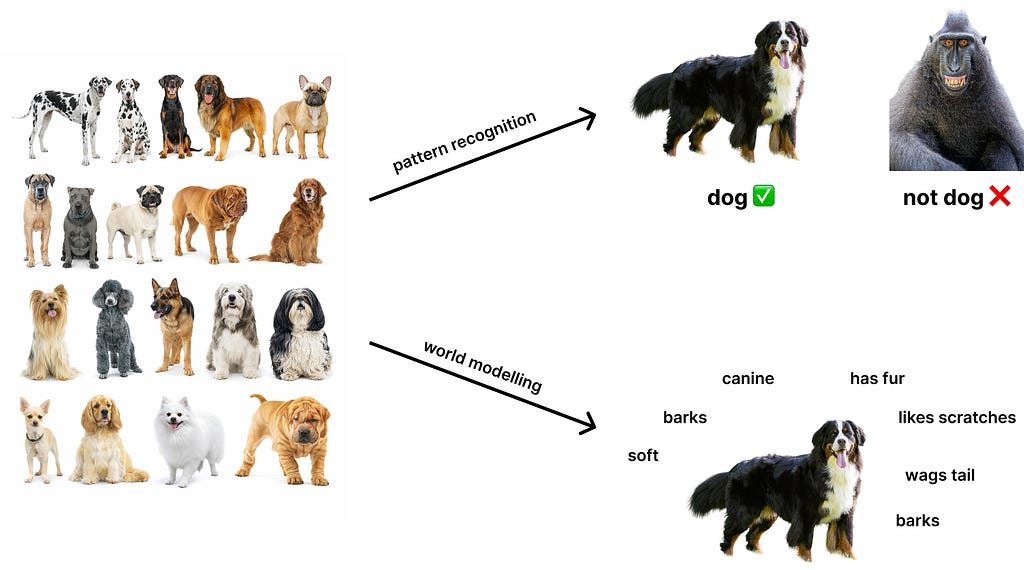
From the point of view of recognising patterns, a child sees many different examples of dogs: all kinds of shapes, breeds, colours, and drooliness levels. Their extremely malleable brain processes all these instances, identifies patterns, and learns to match new examples to this pattern. Very quickly they learn to classify new exemplars as either “dog” or “not dog.”
If the latter sounds extremely similar to a basic-level explanation of machine learning, it’s not by coincidence: artificial intelligence as a field — and especially the view of intelligence as pattern recognition — has been heavily influenced by child development research. In “Computing Machinery and Intelligence,” Turing referred to an artificial intelligence system as a “child-machine”; early pioneers of modern AI research in the 70s explicitly stated the connection between the two fields. For example, in 1972 computer scientist Roger Schank wrote that:
We hope to be able to build a program that can learn, as a child does, how to do what we have described in this paper instead of being spoon-fed the tremendous information necessary.
A similar sentiment was expressed by Marvin Minsky, one of the “fathers of AI,” in 1974:
I draw no boundary between a theory of human thinking and a scheme for making an intelligent machine; no purpose would be served by separating these today since neither domain has theories good enough to explain or to produce enough mental capacity.
And it’s not surprising why a child’s mind is so fascinating to an AI researcher: after all, we spend our early days being unable to speak or hold our head up, yet we develop object permanence by five months old, can distinguish our native language from a foreign one by six months, and perform cost-reward analysis by ten months old. And all of that without the massive datasets that systems like GPT, Claude, and Llama require: a modern large language model (LLM) trains on trillions of words, while an average five-year-old is exposed to around 300,000. How can we learn so much from so little, and so fast?
Both cognitive and computer scientists today mostly agree that intelligence comprises both statistical learning and world model building. But, for reasons I won’t detail here, modern AI research from major industry labs has largely abandoned the question of how children learn so efficiently, focusing instead on whether similar behaviour can be achieved through massive computing power and large training datasets. Still, the original question persists in a new field that has been developing alongside traditional psychology and computer science: computational cognitive science, which continues to ask what artificial intelligence can reveal about the nature of human minds.
From machines to minds
Despite AI’s origins in the study of human cognition, that connection has all but disappeared from public awareness. Yet while mainstream AI research has pivoted toward achieving human-like behaviour without needing to implement a sophisticated human-like cognitive architecture, a a swiftly developing new field—computational cognitive science — has been figuring out ways to use AI models as windows into human cognition.
The logic is fairly straightforward: if artificial neural networks are modelled (however loosely) on biological ones, then understanding how an AI system solves a problem could offer clues about how humans solve it too. This approach is sometimes called “reverse-engineering” cognition: build a system that can perform a human task, decipher how it accomplishes that task, then ask whether humans might be doing something similar.
And so far, the results have been impressive. Since at least GPT-4, LLMs have been able to solve difficult tasks across mathematics, coding, vision, medicine, law, psychology, and more.
But a few concerns remain. First, AI learns from significantly more data than humans (very few of us can brag that we have read all of Wikipedia). Second, while AI can certainly be impressive, it still often falls short at some basic tasks that require symbolic manipulation.
For example, Yale University professor Tom McCoy and colleagues found that state-of-the-art LLMs struggle with seemingly simple tasks like forming acronyms, decoding shift ciphers, and translating into Pig Latin — tasks that require symbolic manipulation following deterministic rules (e.g., “count the number of words in a list”). What’s revealing is that LLMs performed significantly worse when the correct answer was a low-probability string, even though these tasks have objectively correct, deterministic answers, and require no probabilistic reasoning whatsoever (unlike questions such as “How likely am I to get stuck in traffic at 5pm in central London?” — where statistical patterns are genuinely useful).
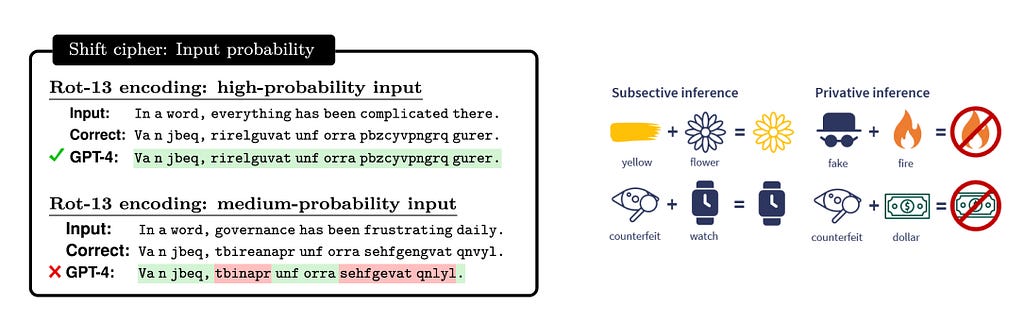
Similarly, when Najoung Kim, a professor of computational linguistics at Boston University, and her colleagues from Harvard University tested LLMs on their ability to make inferences from adjective-noun combinations (for example, the answer to Is a counterfeit watch still a watch? should be Yes, but the answer to Is a fake doctor still a doctor? should be No) they found that these models struggled with low-probability, unusual combinations such as a homemade cat.
The takeaway appears simple: AI is extremely good at learning and generalising information, but it is limited by the tasks it was trained on. As McCoy and colleagues conclude in their paper:
We should absolutely recognize [LLMs’] advanced properties. Nonetheless, we should also remember a simpler fact: Language models are… language models! That is, they are statistical next-word prediction systems […] In sum, to understand what language models are, we must understand what we have trained them to be.
At this point, it seems appropriate to ask: is it even possible to study AI models as proxies for the human mind, when their performance is so clearly underpinned by amounts of training data that no human would process in a lifetime, and an architecture that relies primarily on statistical processing?
Recently, researchers have been trying to solve this problem by introducing additional constraints on how AI systems work: limiting and curating the data they are trained on, and tweaking the architecture to approximate the cognitive biases innate to human mind.
Researchers from Princeton University’s Human & Machine Intelligence Lab, directed by Brenden Lake, trained a generic neural network on 61 hours of video footage that came from a head-mounted camera worn by a single child over the course of 1.5 years. The simple architecture of the model allowed the researchers to test a simple theory of word learning: that novel words are learned by tracking co-occurrences of visual and linguistic information. The model tracks visual and linguistic inputs, which are in turn passed through the visual and linguistic encoders, and embedded in a shared vector space. In other words, the model tracks what kind of visual information accompanies verbal cues like “cat” or “toy,” just like a child might.
And while despite being trained on a tiny dataset — by today’s standards — it worked. When the researchers tested the model on a new set of images, it matched the words it learned during training with the correct visual referents, even though it hadn’t “seen” those specific images before. This finding goes beyond just achieving impressive performance: it provides evidence that word learning in humans could be possible through a general-purpose cognitive mechanism that combines representation and associative learning.

This research suggests that the path to understanding the mind (and as a consequence, building better AI) lies in training models on less data, but thinking more carefully about the kinds of cognitive biases they should be imbued with.
And it clearly aligns with the original mission of AI research. The New York Times article covering this research concludes:
For Dr. Lake, and for other investigators like him, these interlocking questions — How humanlike can we make A.I.? What makes us human? — present the most exciting research on the horizon.
But is this approach likely to become prevalent in industry labs that lead the development of state-of-the-art models like GPT? Logically, it should: front loading effort and resources into building more interpretable models now would ensure their longevity (even now, a mere year after the introduction of ChatGPT, many young people are rejecting what they consider to be “AI slop”). But for commercial labs guided by generating profits and appeasing shareholders, this seems unlikely: why bother spending resources on uncomfortably vague research when increasing computing power and training data have done the trick just fine? The same New York Times article points out:
But mainstream industry labs behind the most competent A.I. models, and the companies that make them, have long been geared toward efficiently processing more data, not making more sense out of less.
Academic research labs face a different version of the same problem. While not driven by pure profit motives, coveted funding sources often mean that their research is still more biased towards building more human-like agents — not creating technology for AI-assisted, more thoughtful and creative human. If we continue this way, where will it lead?
What happens after AI passes the capitalist Turing test?
We have found ourselves at a crossroads. On one hand, we seemingly understand more than ever about how humans think, learn, process visual information, and interact socially. On the other, this knowledge is being channeled almost exclusively toward building better AI chatbots that mimic human behaviour.
Why? First, because the direction is set by for-profit companies whose ultimate goal isn’t ushering in a new Age of Enlightenment, but selling a product — making us more reliant on AI agents to simplify workflows, optimise routines, delegate tasks. Think less, less, less.
Second, for that purpose, research that focuses narrowly on pattern recognition and statistical processing does just fine. These systems are straightforward to train and improve, and their performance is impressive enough to sustain public interest and turn in profits. They pass the capitalist Turing test.
But here’s the trouble: reports of depleting critical thinking and shortening attention spans might just not be fear-mongering, but a direct outcome of systems designed solely for performance. If we spend our thinking time communicating with machines optimised for pattern matching, we might internalise those same patterns to make the interaction more efficient.
The crux of the matter is that interaction with AI is now predominantly designed to imitate a conversation, and we typically expect our conversational partners to have their own intentions, beliefs, and inner lives. In linguistics, it has been well documented that during a human-to-human conversation, people adapt to each other’s language patterns to align their mental states and ultimately achieve better communication. But AI has no mental states it can align with ours. It cannot restructure its foundation — built on statistics and patterns — to match our symbolic reasoning. And as a result, instead of AI becoming a thinking companion, our own thinking risks becoming more machine-like: fine-tuned to recognise statistical regularities while forgetting how to make inferences, form concepts, find deeper connections between things.
So… what’s next? This is where things fall apart, because a crucial piece of understanding is missing: we’re still far from fully grasping how concepts are formed, or how symbolic reasoning is actually instantiated in the brain. And without that understanding, we can’t build systems that genuinely complement human intelligence rather than flatten it. In order to get there, three things need to happen:
- Industry research labs need to engage seriously with cognitive science and collaborate with academic researchers. If I’ve made my point clear, artificial intelligence research loses much of its substance when it severs ties with the foundational questions that connected it to philosophy of mind and cognitive development. For progress to be truly significant, these ties must be restored and strengthened.
- AI systems need cognitively plausible architectures. In modern cognitive science, biological plausibility plays a crucial role: if a proposed mechanism is impossible to implement biologically, that casts serious doubt on its validity. The same standard should apply to AI. Researchers need to think carefully about what data models are trained on and why certain architectures are chosen — not just whether they work, but whether they reflect anything meaningful about intelligence.
- Most crucially, software designers and cognitive scientists need to collaborate on how these systems can actually serve humanity. No one else can figure this out — and many designers already agree that chat interfaces are a poor solution.
There’s a brand of AI optimism that says what you get out of AI depends on how you use it: if you’re filling knowledge gaps rather than taking shortcuts, you’ll unlock creativity and thinking rather than rot your brain on slop.
I subscribe to this optimism to a degree. As a designer, AI has allowed me to move beyond technical constraints and create more freely.
But this “solution” is rooted in individualism and, frankly, elitism: the idea that AI will make only the smartest and most discerning among us even brighter and more capable. There’s nothing in that promise about elevating humanity as a whole. Yet research shows that real progress is impossible without collective intelligence. If AI is to fulfil its promise as a tool for thought — a genuine extension of human capability — it must be designed not just for individual optimisation, but for collective progress.
References
Turing, A. M. (1950). Computing machinery and intelligence. Mind, 59(236), 33–60.
Hebb, D. O. (1949). The Organization of Behavior: A Neuropsychological Theory. New York: Wiley and Sons.
Lake, B. M., Ullman, T. D., Tenenbaum, J. B., & Gershman, S. J. (2017). Building machines that learn and think like people. Behavioral and Brain Sciences, 40, e253.
Ross, H., Davidson, K., & Kim, N. (2024). Is artificial intelligence still intelligence? LLMs generalize to novel adjective-noun pairs, but don’t mimic the full human distribution. arXiv preprint arXiv:2410.17482.
McCoy, R. T., Yao, S., Friedman, D., Hardy, M., & Griffiths, T. L. (2023). Embers of autoregression: Understanding large language models through the problem they are trained to solve. arXiv preprint arXiv:2309.13638.
Wai Keen Vong et al. Grounded language acquisition through the eyes and ears of a single child. Science 383, 504–511 (2024).
Branigan, H. P., Pickering, M. J., & Cleland, A. A. (2000). Syntactic co-ordination in dialogue. Cognition, 75(2), B13-B25.
Brennan, S. E., & Clark, H. H. (1996). Conceptual pacts and lexical choice in conversation. Journal of experimental psychology: Learning, memory, and cognition, 22(6), 1482.
Maggie Appleton. A Treatise on AI Chatbots Undermining the Enlightenment. https://maggieappleton.com/ai-enlightenment#our-missing-pocket-sized-enlightenment
Celine Nguyen. How to speak to a computer. https://www.personalcanon.com/p/how-to-speak-to-a-computer
When AI passes the capitalist Turing test was originally published in UX Collective on Medium, where people are continuing the conversation by highlighting and responding to this story.