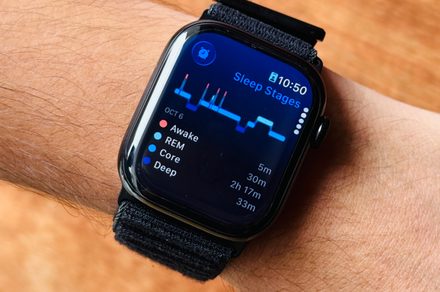
I’m generally reluctant to wear my Apple Watch while I sleep. Yes, I can silence the notifications on the watch to avoid on-wrist audiovisual distractions. I wake up just fine with a phone alarm, and don’t need the watch to push beeps into my ears.
The disdain is somewhat justified because I bought the smartwatch primarily for workout tracking. Plus, I just can’t sleep with a device strapped to my wrist. It’s just uncomfortable. But the attitude has mellowed down lately.
My family physician has lately forced me to get at least 7-8 hours of shut-eye time to ensure that my seizures don’t relapse. And since I am required to submit a record of my sleep data for monthly evaluation, I try my best and take the watch to bed.
But it appears that the Apple Watch has been doing more for my sleep — and overall health — than I knew. Or even what Apple advertised. And I think I am going to cultivate a habit of sleeping with the Apple Watch for the sake of my cardiac and neurological health, irrespective of whether I like it or not.

New research just revealed that deviating from your usual bedtime can increase the risk of sleep apnea and hypertension. And here’s the fun part. The Apple Watch already has a metric in place that keeps an eye on your sleep schedule disruptions, and it can measure blood pressure spikes, as well.
What finally changed my mind
Scientists over at Scripps Research, a leading non-profit biomedical research facility, analyzed the efficacy of digital activity trackers such as the Apple Watch, Fitbit wearables, and the Oura ring. The target was assessing the sleep data as part of a study called the Research Framework for Exploring Sleep Health (REFRESH).
The team recruited over a thousand adults across the country, and they contributed an average of two years’ worth of sleep data collected by wearable devices. The core objective was to study their sleeping behaviors, broadly categorizing them as night owls or early risers. At the end of the study, the team discovered that even an hour’s worth of delay in the routine bedtime significantly increases the chances of sleep apnea and hypertension.

The findings, which are published in the Journal of Medical Internet Research, note that a single hour delay in the regular bedtime of participants had “more than twice the risk of sleep apnea and were 71 percent more likely to have high blood pressure.”
Labeling it as a “robust” and “compelling association” between sleep variability and health conditions such as sleep apnea and elevated blood pressure, the team advocates that wearable devices such as the Apple Watch can be deployed for early disease detection and prevention.
“Right now, we’re in the pattern-recognition phase. We’re confirming these associations exist and understanding mechanisms,” assistant professor at Scripps Research, Stuti Jaiswal, was quoted as saying. The impact, however, could be significant for millions of people across the world, including myself.
Apple Watch already logs my bedtime discipline

As per a paper published in the Lancet Respiratory Medicine journal, obstructive sleep apnea (OSA) affects nearly a billion people globally. In the US, the estimates vary between 30 to 60 million adults, a number that is expected to reach a staggering 77 million by 2050.
Now, sleep apnea can be of different magnitudes, but the impact runs deep. In severe cases, it can impair cognition, mood, and daytime alertness. Studies have also highlighted a high prevalence of cardiac arrhythmias in patients with severe sleep apnea. It’s widely known that sleep apnea is linked to an increased risk for cardiovascular and metabolic health issues.
And here’s the scariest part. “You might not even know you have this very common problem,” note the experts at John Hopkins Medicine. Thankfully, the Apple Watch can now flag signs of moderate to severe sleep apnea by keeping an eye on the movement of your body while asleep to detect breathing disturbances.

As per the latest study from Scripps Research, your bedtime routine can have an impact on your sleep apnea risks. This is where Apple’s latest Sleep Score system comes into the mix. This new feature takes into account three core metrics — duration of sleep (50 points), interruptions (20 points), and how closely you stick to your bedtime schedule (30 points).
Based on these three scores, the Apple Watch assigns a score between 0 and 100, broken across five quality tiers. The study from Scripps Research focuses on the latter aspect, which is how closely you adhere to the bedtime schedule. Apple has been tracking this metric for months, and I am finally realizing its true importance.
A deeper peek into blood pressure woes

The Apple Watch also comes with a feature called Hypertension Notifications. As the name suggests, it can sense and alert users about hypertension, also known as chronic high blood pressure. Affecting over a billion people across the world, hypertension elevates the risks of heart attack, stroke, and kidney disease.
The most worrisome part is that, just like sleep apnea, there are no telltale symptoms of hypertension. The Apple Watch lends a helping hand here. The optical biosensor on the smartwatch measures how the blood vessels contract and expand with heartbeats, and algorithmically detects abnormal movements.
This is how it ties into the latest research. If you receive a hypertension alert on your Apple Watch, and you are not sure what to do next, you can check your sleep history and see if your bedtime has been consistent lately. This can be done either by looking at your sleep score logs or even the broad sleep history.

And while at it, you might also want to check the Vitals app, which tracks five metrics — heart rate, respiratory rate, blood oxygen levels, wrist temperature, and sleep duration — overnight. The best course of action, of course, is to visit a doctor. But armed with insights about the bedtime history, you have more crucial insights to share with your doctor for a more accurate diagnosis.
Experts at Scripps Research note that further analysis is required to understand just how deep is the interplay between bedtime schedule and hypertension risks, but they can already see a visible link. I’m just glad that the Apple Watch on my wrist can already measure these metrics, and I can reliably monitor them for my physical well-being. And if that means wearing it to bed, I am willing to live with the inconvenience.